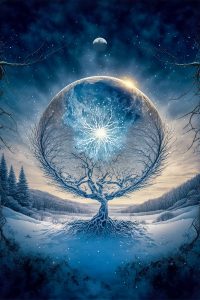
 As winter deepens and the northern winds turn sharp with their song, we approach Yule—the ancient celebration marking the longest night of the year. This turning point, the Winter Solstice, is often spoken of as the return of the light. Yet before the first spark brightens the horizon, there is the stillness, the darkness, and the invitation to pause. Yule is a threshold, a liminal moment when the world holds its breath, and we are asked to look inward, to remember, and to listen.
The darkness of Yule is not empty or foreboding; it is full, alive, and brimming with the presence of those who came before us. It is the domain of the dark goddesses—figures who have been honoured across traditions, continents, and centuries. Whether we speak of Hekate standing at the crossroads, the fierce embrace of Kali, the deep underworld wisdom of Ereshkigal, or the wintry stillness of the Cailleach, these goddesses teach us that darkness is not a place of fear but a place of truth. It is a realm where illusions fall away, and the soul meets itself honestly.
In the long night of Yule, we enter their temple.
These goddesses remind us that endings are sacred, that death is part of the cycle of life, and that deep introspection is not a withdrawal but a return—to our roots, our essence, and our lineage. And perhaps this is why Yule has always been connected with honouring the ancestors. When the world quiets and the veil feels thin, we feel them: the ones whose blood runs through us, whose stories shaped our inheritance, whose lives form the ground on which we stand.
For my family, Yule became a celebration precisely because of this ancestral pull. It did not begin as a festival in its traditional sense, nor as an attempt to follow any particular pagan calendar. It was born out of grief—raw, collective, and aching. We needed a space to honour those we had lost, to speak their names, to celebrate their lives, and to recognise the pain we all shared but didn’t always know how to voice.
What began as a moment of remembrance became a yearly tradition. A single need turned into a ritual. And that ritual has now woven itself into the fabric of who we are as a family.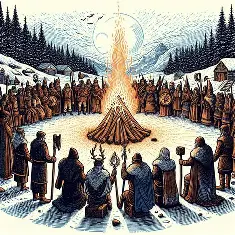
Every year at Yule, we gather—quietly, gently, and with intention. Fires are lit, names are called, stories retold. There is laughter and sorrow, tenderness and silence. We speak of their quirks, their teachings, their mistakes, and the gifts they unknowingly left behind. There is no script, no formal ceremony, just the warm familiarity of a tradition shaped by love and loss.
And something beautiful has happened within this continuity: the youngest members of our family have grown up understanding that death is not an erasure, but a transformation. They have learned that those who depart do not vanish; they shift into memory, into legacy, into the unseen threads that guide our steps. They have learned gratitude—for where they come from, for the people they belong to, and for the lineage that holds them. They connect on a special level on this day, sharing their wishes, their longings, their desires, knowing that our loved ones are listening with the same love that we profess for them.
In a culture that often looks away from death, our Yule has become a quiet rebellion. A conscious refusal to forget. A way of saying: We remember. We honour. We continue.
It is a moment that bridges generations, allowing the elders to pass forward stories, traditions, and the soft teachings that the departed left behind. And it gives the children permission to carry these stories into the future, reshaping them, adding their own experiences, and continuing the tapestry of our family’s identity.
Yule reminds us that darkness is not simply the absence of light; it is the womb of possibility, the space where reflection becomes transformation. In these still nights, we learn to sit with ourselves, to listen, and to let the quiet do its work. It is a season that teaches patience, humility, and the value of slowing down. A season that honours both the living and the dead.
And as we gather again this year—around the fire, stories, shared food, and shared memory—we step into a lineage far older than our family alone. We join the ancient rhythm of humanity: remembering at the darkest time of the year, trusting the return of the light, and celebrating the sacred threads that bind us across time.
This is Yule.
A time of introspection.
A time of honouring.
A time of ancestral presence.
A time to remember who we are and where we come from.
And for us, it is a reminder that from shared pain can blossom shared meaning—and from remembrance, a family tradition that carries us forward.
Hari Om Tat Sat