 Within the Vedic tradition, mantra meditation is one of the most direct and profound ways of moving from dharana (concentration) into dhyana (meditation). It offers not only a technique for focusing the mind, but a living relationship with sound as consciousness itself—a pathway through which the individual mind becomes attuned to something deeper, more stable, and more expansive.
A mantra is not simply a word or phrase. It is understood as sabda—vibrational consciousness, carrying both meaning and energetic resonance. In this sense, the mantra becomes a subtle object of focus, perfectly suited for dharana. The repetition of mantra—japa anchors the mind, giving it a rhythm and direction. For a mind that is scattered, restless, or emotionally charged, mantra provides containment through sound, gently drawing awareness back again and again.
This process reflects the essence of concentration. The practitioner applies effort, guided by Buddhi, to remain with the mantra. Thoughts may arise, attention may drift, but the mantra becomes the point of return. Over time, this repetition begins to stabilise the inner field, much like breath awareness or visual focus.
Yet, as with all authentic yogic practices, something begins to shift when the effort becomes steady. The repetition softens, the mind quiets, and the mantra starts to feel less like something we are “doing” and more like something we are receiving or entering into. This marks the transition into dhyana. The mantra continues, but now with continuity and ease. In this way, mantra becomes a bridge—from effort to flow, from individual control to participation in a deeper field of consciousness.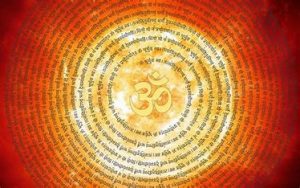
The Bhagavad Gita offers a subtle but powerful foundation for this understanding. In Chapter 10. 25, Krishna declares: “Among sacrifices, I am japa.” Here, mantra repetition is elevated to a sacred act—an inner offering that connects the individual to the divine. It is not merely mental discipline, but relationship and devotion expressed through sound. Similarly, in Chapter 8.13, the Gita refers to the recitation of Om as a means of remembering the Supreme at the time of death: “Uttering the syllable Om, the one-syllabled Brahman…”. This points to the deeper function of mantra—not only as concentration, but as alignment with ultimate reality (Brahman). The mantra becomes a thread linking the finite mind to the infinite.
Other Vedic texts, particularly the Upanishads, deepen this view. The Mandukya Upanishad describes Om as the totality of consciousness—waking, dreaming, deep sleep, and the transcendental state beyond. To meditate on a mantra, therefore, is not simply to repeat a sound, but to attune oneself to the structure of consciousness itself.
From a Vedic counselling perspective, mantra meditation holds a uniquely integrative role. Psychologically, it soothes the nervous system, regulates thought patterns, and reduces rumination. For Vata types, it provides grounding through rhythm; for Pitta, it softens intensity; for Kapha, it can gently stimulate clarity and upliftment. But beyond these regulatory effects, mantra also reorients identity. It shifts attention away from the constant narrative of the mind toward a deeper, more stable field of awareness.
 In the counselling space, mantra may be introduced not as a rigid discipline, but as a supportive companion to inner work. The client is invited to explore the mantra as something that holds them when their own mind feels unstable—an anchor that is both psychological and sacred. Over time, this relationship deepens. The mantra is no longer just a tool; it becomes a presence. This reflects the deeper movement from dharana to dhyana. In dharana, we repeat the mantra. In dhyana, we begin to rest in it. And eventually, even the distinction between the one who repeats and the sound itself begins to dissolve.
In this way, mantra meditation reveals its full significance. It is not only a method of concentration, nor only a form of meditation. It is a bridge between the personal and the universal, between effort and surrender, between the thinking mind and the quiet recognition of something greater.
For Vedic counselling, this is essential. Healing is not only about regulating the mind, but about reconnecting the individual with a deeper ground of being. Mantra offers a path that is at once simple and profound—guiding attention, calming the psyche, and opening the possibility that beneath the noise of thought, there is a steady, resonant presence that has always been there.

Hari Om Tat Sat