Exploring the Unconscious Field in Transpersonal Psychology
Human beings do not exist in isolation. We are shaped by our relationships, our family history, our culture and the experiences that have contributed to our understanding of ourselves and the world.
Sometimes, however, a difficulty in the present seems to have a depth that cannot easily be explained by our conscious story. We may experience recurring relationship patterns, unexplained fears, difficulties with belonging, grief, loyalty conflicts, questions around identity or a persistent sense that something is preventing us from moving forward.
Family Constellations can offer an experiential way of exploring these dynamics.
Within a transpersonal approach, a constellation can be understood as a method of inquiry into the layers of experience that may exist beyond ordinary conscious awareness. Rather than assuming that every difficulty originates within the individual, it invites us to explore the relational and systemic context in which the person has developed.
Looking beyond the individual
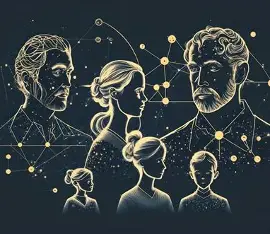 Family Constellations originated from the work of Bert Hellinger and subsequently developed through a variety of systemic, therapeutic and experiential approaches. Traditionally, the method explores family relationships and patterns across generations, sometimes including experiences such as loss, exclusion, migration, separation, trauma and unresolved grief.
The central premise is that individuals can be influenced by their relational systems and by patterns that may have developed before they were born.
From a psychological perspective, some of these patterns can be understood through attachment, family systems, learned behaviours, implicit memory and intergenerational transmission of trauma. From a transpersonal perspective, the exploration can go further, allowing space for symbolic, intuitive and existential dimensions of experience.
This does not require us to assume that every sensation, image or perception emerging during a constellation represents an objective historical fact.
Instead, the constellation can be approached as a symbolic and experiential language through which the client may discover something meaningful about their inner world.
Entering the “field”
One of the distinctive characteristics of constellation work is the creation of a relational “field”.
In a group setting, participants may represent members of the client's family or significant elements of the client's experience. The client observes the arrangement and, at different stages, may interact with the representatives or alter their positions.
This spatial representation can make something previously abstract visible.
A relationship that has existed only as an internal experience suddenly has a physical representation.
A client may begin to recognise:
“I have been carrying responsibility that does not belong to me.”
“I have never allowed myself to grieve this loss.”
“I have been trying to belong by abandoning my own needs.”
“I am repeating something I thought was simply my personality.”
The value may therefore lie not in proving a particular family narrative, but in creating an experience through which new perspectives become possible.
Constellations beyond the family tree
Although Family Constellations are commonly associated with ancestral and family dynamics, the method can also be used to explore issues that are directly present in the client's life.
A constellation may explore a relationship, a career dilemma, a health-related emotional experience, grief, a decision, an internal conflict, a sense of purpose or another significant life problem.
In this context, the “elements” of a constellation do not necessarily need to represent family members. They may represent different aspects of the client's experience — for example, fear, freedom, responsibility, a relationship, an unmet need or an imagined future.
This versatility makes the method particularly interesting within transpersonal psychology.
The work can move between the personal, relational, systemic and transpersonal dimensions of experience, while remaining centred on the client's own process.
Group and individual work
 Constellations can be facilitated within groups or adapted for individual sessions.
In group work, representatives provide a living, relational dimension. The client may observe how the system is represented externally, while the presence of other people can create a powerful experience of witnessing, recognition and shared humanity.
Individual constellation work can use objects, markers, chairs, drawings, visualisation or other symbolic representations. This can be particularly useful when a client prefers greater privacy or when the therapeutic work requires a more contained environment.
Both formats can create opportunities for perspective-taking and experiential learning.
What does the research tell us?
Research into Family Constellations is developing, although it remains considerably smaller than the evidence base for established psychotherapies.
A 2021 systematic review identified 12 quantitative prospective studies involving 568 participants. Nine reported statistically significant improvements following constellation interventions, and a meta-analysis of five studies examining general psychopathology found a moderate effect size. However, the authors emphasised that the overall quantity and quality of evidence was low.
An updated review published in 2021 identified 14 studies involving 590 participants and again reported improvements across several outcomes, including self-image, psychopathology and perceived family functioning. However, the researchers similarly concluded that further high-quality randomised controlled trials were necessary.
More recently, a 2024 randomised controlled trial examined a pandemic-adjusted form of systemic constellation therapy, involving 80 participants and follow-up at one and six months.
Importantly, a 2026 systematic review and meta-analysis of randomised controlled trials reached a much more cautious conclusion, reporting that the available trials were at high risk of bias and that the certainty of evidence was very low. The authors concluded that robust evidence supporting clinical effectiveness has not yet been established.
This evolving evidence base encourages a responsible position: Family Constellations can be valuable as an exploratory and experiential intervention, but its theoretical explanations and clinical efficacy should not be presented as scientifically established in the same way as better-researched therapeutic approaches.
A transpersonal invitation to exploration
The potential of constellation work may ultimately lie in its capacity to help a person see their experience differently.
In therapy, insight does not always emerge through intellectual analysis alone. Sometimes we need to experience something, represent it, embody it or encounter it from another perspective before we can understand it.
A constellation can create such a space.
It can invite the client to explore what belongs to their personal biography, what may have been learned within their family system, what may have been carried through relationships, and what meaning they have given to these experiences.
From a transpersonal perspective, this exploration can also open questions of identity, belonging, purpose, meaning and connection.
The intention is not to impose a story upon the client.
It is to create a safe enough space for something previously unconscious, unspoken or difficult to conceptualise to become available for reflection.
Ultimately, the most valuable question may not be:
“Is this exactly what happened in my family?”
but rather:
“What is this experience showing me about how I have been living — and what becomes possible if I see it differently?”
Used ethically, with appropriate therapeutic boundaries and without presenting symbolic experiences as factual evidence, Family Constellations can become one instrument within a broader transpersonal therapeutic approach: a way of exploring the visible and invisible dimensions of human experience while supporting greater awareness, integration and freedom in the present.
Hari Om Tat Sat