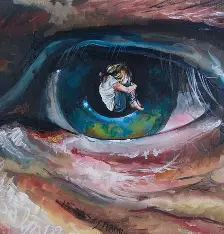
 Grief is often associated with death, yet loss is a far broader human experience. We grieve not only the death of loved ones but also the loss of relationships, opportunities, identities, dreams, health, safety, and versions of ourselves that once existed. Grief is a deeply personal process shaped by culture, spirituality, family systems, life experiences, and our individual capacity to make meaning from suffering.
From an intersectional perspective, grief cannot be understood through a single lens. Our cultural background may determine how emotions are expressed, whether mourning is communal or private, and what rituals support the grieving process. Spiritual and religious beliefs often provide frameworks that help individuals understand death, impermanence, and the continuity of life. For some, faith offers comfort through beliefs in reincarnation, heaven, ancestral connection, or the soul's journey. For others, grief may challenge existing beliefs, leading to questions, doubt, and spiritual crisis.
Psychologically, grief has been studied through various theories that help us understand the complexity of loss. One of the most widely recognised models is Elisabeth Kübler-Ross's five stages of grief: denial, anger, bargaining, depression, and acceptance. While influential, this model is often misunderstood as a linear progression. In reality, grief rarely unfolds in neat stages. Individuals may move back and forth between emotions, experience several simultaneously, or not experience some stages at all.
More contemporary understandings view grief as an ongoing process of adaptation. The Dual Process Model proposed by Margaret Stroebe and Henk Schut suggests that healthy grieving involves oscillating between confronting the loss and engaging with life beyond it. This movement between sorrow and restoration allows individuals to gradually integrate the reality of their loss while continuing to participate in everyday life.
 The impact of grief on mental health can be significant. Feelings of sadness, numbness, anxiety, guilt, anger, and loneliness are common responses to loss. Sleep disturbances, changes in appetite, difficulty concentrating, and emotional exhaustion often accompany the grieving process. While grief itself is not a mental illness, prolonged or complicated grief may increase vulnerability to depression, anxiety disorders, substance misuse, and other psychological difficulties. Understanding these responses as natural adaptations to loss can help reduce shame and self-judgement during times of suffering.
Importantly, grief is not limited to what has been lost in the present. Many people grieve futures that never materialised. We may mourn the career that never happened, the relationship that ended before it fully began, the family we imagined having, or opportunities that circumstances prevented us from pursuing. These forms of grief are often invisible and socially unrecognised, yet they can be profoundly impactful. The pain of "what could have been" carries its own weight and deserves the same compassion as more visible forms of loss.
This understanding of grief connects closely with trauma recovery. In her seminal work Trauma and Recovery, psychologist and psychiatrist Judith Herman identifies mourning as a central stage in the healing process. Following the establishment of safety and the reconstruction of traumatic memories, individuals are invited into a process of grieving what trauma has taken from them. This may include the loss of innocence, trust, security, relationships, opportunities, identity, or a sense of control over one's life.
Within Herman's framework, grief is not merely a response to death but a necessary part of reclaiming life after adversity. Healing requires acknowledging the reality of what has been lost while also creating space for new meaning, connection, and possibility. This process does not erase pain, nor does it suggest that individuals should simply "move on." Rather, it involves learning how to carry loss differently, allowing it to become part of one's story without defining one's entire existence.
Spiritual traditions across the world often echo this understanding. Many teachings emphasise the impermanence of life, the inevitability of change, and the importance of acceptance. Practices such as prayer, meditation, contemplation, ritual, and community support can provide grounding during periods of grief. These practices may help individuals connect to something larger than themselves, fostering resilience and meaning in the face of suffering.
Ultimately, there is no right way to grieve. Some people express emotions openly, while others process internally. Some seek community, while others require solitude. The pace of grief is unique to each individual and influenced by personality, attachment history, cultural values, spiritual beliefs, previous experiences of loss, and the nature of the relationship or opportunity that has been lost.
Grief is not something to be fixed. It is a natural response to loving, hoping, dreaming, and being human. While loss changes us, it can also invite reflection, compassion, deeper self-understanding, and renewed connection with what truly matters. In allowing ourselves to grieve, we honour both what has been lost and the enduring capacity of the human spirit to heal.
Hari Om Tat Sat