Exploring the Three Worlds of Shamanic Cosmology Through Journaling
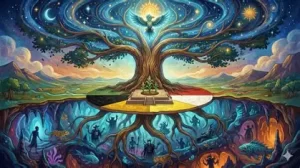 Across many indigenous and shamanic traditions, the universe is understood as an interconnected living reality, where the human experience is part of a greater relationship between the Earth, the natural world, the ancestors, and the spirit realm. At the heart of this understanding lies the concept of the Axis Mundi—the sacred axis or world tree that connects the three worlds: the Lower World, the Middle World, and the Upper World.
This cosmological model offers more than a spiritual map. It can also be understood as a symbolic framework for exploring different dimensions of our inner lives, reconnecting with forgotten aspects of ourselves, and developing a deeper relationship with the spiritual dimension of existence.
Although interpretations differ across cultures, the three-world cosmology is particularly associated with certain Siberian and Central Asian shamanic traditions and has also been popularised in contemporary shamanic practices, including the work of Michael Harner. It is important to recognise that indigenous traditions are diverse and should not be reduced to one universal system. Nevertheless, the image of the world tree offers a powerful language through which we can explore our own relationship with life.
The Axis Mundi: The Sacred Connection
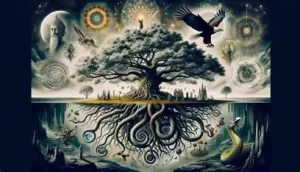 The Axis Mundi represents the central point of connection between the different dimensions of existence. It is often symbolised by a tree, mountain, pillar, or sacred structure whose roots reach into the depths of the Earth, whose trunk occupies the living world, and whose branches extend towards the heavens.
The tree becomes a metaphor for our own existence. We are simultaneously rooted in our history, embodied in the present, and reaching towards possibility, meaning, and transcendence.
Through this image, the three worlds can be approached as three complementary dimensions of the self, each offering different gifts and opportunities for awareness.
The Lower World: Roots, Instinct and Inner Wisdom
The Lower World is traditionally associated with the Earth, ancestral knowledge, animal spirits, and the deeper forces of nature. It is not a place of darkness or negativity, but a realm of grounding, vitality, instinct, and connection with the foundations of life.
Symbolically, it invites us to explore our unconscious patterns, emotional foundations, early experiences, and relationship with our bodies. It is the territory of what lies beneath conscious awareness: our fears, wounds, survival mechanisms, but also our resilience and innate wisdom.
Its gifts include grounding, protection, courage, belonging, and the recovery of forgotten strengths.
Through journalling, we might explore:
- What are the foundations upon which I have built my life?
- Which inherited patterns or old beliefs continue to influence me?
- What aspects of myself have I neglected or forgotten?
- What does my body know that my conscious mind has not yet recognised?
The Lower World invites us to reconnect with our roots, honour our history, and recover the resources that allow us to feel grounded and whole.
The Middle World: Embodiment, Relationships and Everyday Life
The Middle World represents the physical and living world we inhabit. It is the realm of relationships, community, nature, responsibilities, and the choices we make each day.
Spiritually, it reminds us that our connection with the sacred is not separate from ordinary life. The way we relate to others, care for our bodies, engage with nature, and fulfil our responsibilities can all become expressions of conscious living.
Psychologically, this world invites us to examine how our inner experiences manifest externally. It offers an opportunity to explore our identity, boundaries, relationships, habits, and capacity to participate meaningfully in the world.
Its gifts include discernment, connection, agency, creativity, and the ability to transform insight into action.
Journalling prompts might include:
- How am I showing up in my relationships and daily life?
- Where am I living in alignment with my values, and where am I compromising myself?
- What relationships nourish me, and which require healthier boundaries?
- What action could I take today to bring greater integrity into my life?
The Middle World reminds us that spiritual growth is not simply about seeking extraordinary experiences. It is also about becoming more present, responsible, compassionate, and conscious in the life we are already living.
The Upper World: Vision, Spirit and Higher Consciousness
The Upper World is traditionally associated with the heavens, celestial beings, spiritual teachers, ancestors, and sources of wisdom beyond ordinary human perception. In different shamanic cosmologies, it may be reached through the branches of the world tree or by ascending a sacred mountain.
Symbolically, it represents our relationship with higher consciousness, purpose, inspiration, and the search for meaning beyond the material aspects of existence.
From an inner-development perspective, the Upper World invites us to explore our aspirations, spiritual identity, values, and connection with something greater than the individual self. It is the dimension of vision, possibility, and transcendence.
Its gifts include clarity, inspiration, compassion, wisdom, and a renewed sense of purpose.
Journalling can help us explore:
- What gives my life meaning beyond my daily responsibilities?
- What wisdom or guidance am I seeking at this stage of my life?
- What would I pursue if I were less influenced by fear?
- How can I cultivate a deeper relationship with spirit, consciousness, or the divine?
The Upper World encourages us to lift our perspective, recognise possibilities beyond our immediate circumstances, and reconnect with the aspirations that give direction to our lives.
Bringing the Three Worlds Together: A Journey Towards Wholeness
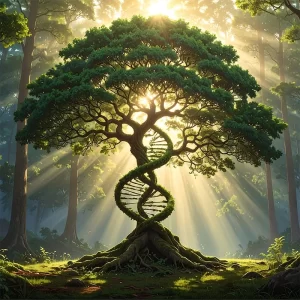 The beauty of the Axis Mundi lies in the relationship between the three worlds. They are not separate territories competing for our attention, but interconnected dimensions of existence.
The Lower World reminds us to be rooted. The Middle World teaches us to be present. The Upper World invites us to expand.
Together, they offer a symbolic journey towards integration: understanding our past, inhabiting our present, and opening ourselves to future possibilities.
In psychotherapy and personal development, this framework can provide a meaningful structure for self-reflection. It allows us to explore the different dimensions of our experience without reducing our identity to our wounds, circumstances, or aspirations alone.
Journalling becomes a way of travelling through these inner landscapes. By giving language to our experiences, we create space for awareness, new perspectives, and the integration of insights into everyday life.
Ultimately, the Axis Mundi reminds us that we are both rooted in the Earth and connected to something greater than ourselves. We carry our history within us, participate in the world around us, and retain the capacity to reach towards meaning, wisdom, and spiritual connection.
Perhaps the greatest invitation of the three worlds is to recognise that wholeness does not come from inhabiting only one dimension of ourselves, but from allowing all three to find their rightful place.
To be deeply rooted, fully present, and spiritually connected: this is the journey of the world tree, and perhaps also the journey of becoming more fully ourselves.